Saint Paul, MN · Garage Door Service
Garage door repair for Lakeland, MN, where most houses date to 1976. Saint Paul Garage Door Pros drives out 16 miles to fix springs, openers, and tracks.
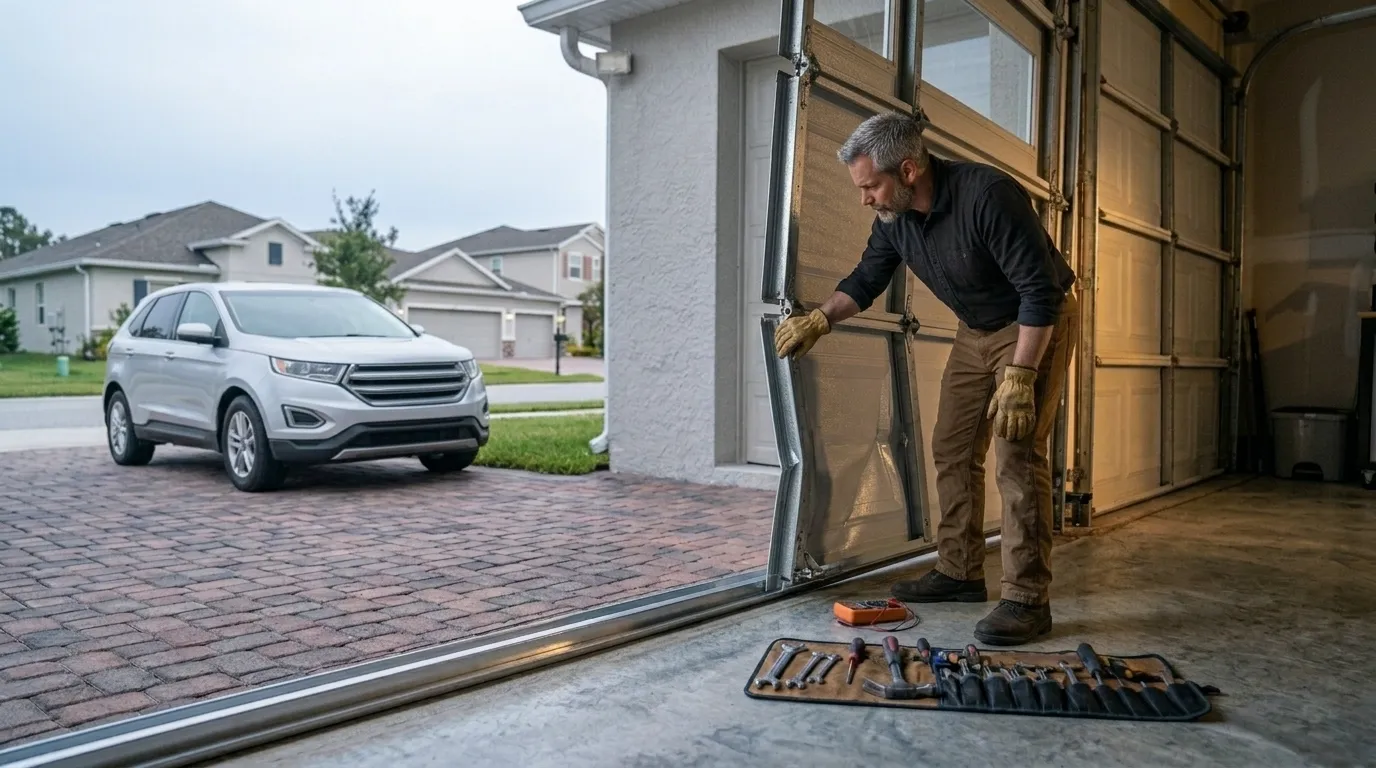
Lakeland sits about 16 miles from Saint Paul, which is where our crew and truck come from - we don't keep a depot or drop box out this way, so every job starts with that drive. It's a straightforward run, but it means we schedule Lakeland calls in blocks rather than as drop-in stops between closer jobs. If you call for a same-day repair, ask what's open on the route; we're often already moving through the river towns on the way out. We don't inflate that distance or pretend it isn't there - 16 miles each way is real drive time, and it's baked into how we price a truck roll here compared to work five minutes from the shop. What doesn't change is the work itself once we're in your driveway: torsion springs, openers, broken rollers, bent track, the same parts we carry for closer jobs. The honest tradeoff is availability, not quality - we may not be able to squeeze in a last-minute Lakeland call on a day already booked solid closer to Saint Paul, and we'd rather tell you that up front than promise a window we can't hit.
The median house here dates to around 1976 - a few years newer than the 1973 median across the broader service area we cover, and that gap matters more than it sounds. Lakeland is a small pocket, just 706 households, which is a fraction of the 253,852 households spread across the 41 named areas we work in. Household income here runs higher too, at $101,339 versus $91,946 for the wider area, which tends to show up in how much people are willing to spend fixing a door right instead of patching it again. Housing built in the mid-1970s in this region generally means single-family construction on standard two-car garages, put up during a building wave that ran through the area from the mid-1950s into the early 2000s. What you don't get much of here is the older 1940s and 1950s housing stock that shows up closer to the city core, with its narrower openings and older hardware. Lakeland's stock is more uniform in age, which actually makes diagnosing common faults a little more predictable once you know what era you're dealing with.
A door installed around 1976 usually means one of two things: the original hardware is still in there wearing out on schedule, or it's already been swapped once for a mid-grade steel replacement sometime in the 80s or 90s. Either way, this era commonly used extension springs mounted along the horizontal track rather than a torsion bar over the header, and those setups fail differently - the cable and pulley wear out as much as the spring itself. The service area sits in a cold, severe climate zone, and that combination of age and weather is rough on old spring steel and on door bottom seals that were never built for today's insulation standards. We regularly find galvanized track that's pitted from decades of winter road salt tracked in on tires, and rollers that were never upgraded from steel to nylon. The honest limitation: if the opener is original to a 1970s install, parts for it are long gone, and we're not going to hunt down obsolete gears when a new opener costs less than the labor to keep patching an antique. Some jobs are a repair. Some are a straightforward replacement, and we'll tell you which is which before we start.
Because Lakeland's housing landed mostly in one era rather than being built up in waves over sixty years, you don't see the mix you'd find closer to Saint Paul, where a 1910s bungalow can sit next to a 2005 infill build. Here the garages tend to match each other in age, width, and header height, which is actually useful information for a repair call - it narrows down what track length and spring wind we're likely bringing off the truck before we've even measured. That said, uniform age doesn't mean uniform condition. A door that's been resprung once already behaves differently than one still running its original hardware, even on an identical house two doors down. We don't have a street-by-street map of which blocks got upgrades and which didn't, and we're not going to guess at it - what we can tell you is that a house built to the area's mid-1970s norm is a known quantity to us, and we'd rather ask a few questions on the phone about the door's history than assume it matches the house next door just because the roofline does.
No. We work out of Saint Paul and drive to Lakeland for every call, about 16 miles each way. We don't keep a satellite location or drop box in the area, so scheduling is built around that drive rather than an on-site crew.
Houses from this era commonly used extension springs on horizontal track rather than a torsion bar setup, and some original openers and drums from that period were phased out decades ago. We carry standard replacement parts, but an exact match to 1970s factory hardware usually isn't available - we replace with modern equivalents instead.
It depends on what's actually worn. A spring or cable swap on solid panels is usually worth doing. If the opener, track, and panels are all original and failing together, replacement often costs less over time than repeated patch repairs - we'll tell you which situation you're in before quoting anything.
Call now or request a free quote - same-day service on most repairs, upfront written pricing.