Saint Paul, MN · Garage Door Service
Service for Hamline - Midway homes built mostly in the 1960s and 70s, matched to original torsion hardware and Minnesota's cold winters. Local, plain pricing, no invented promises.
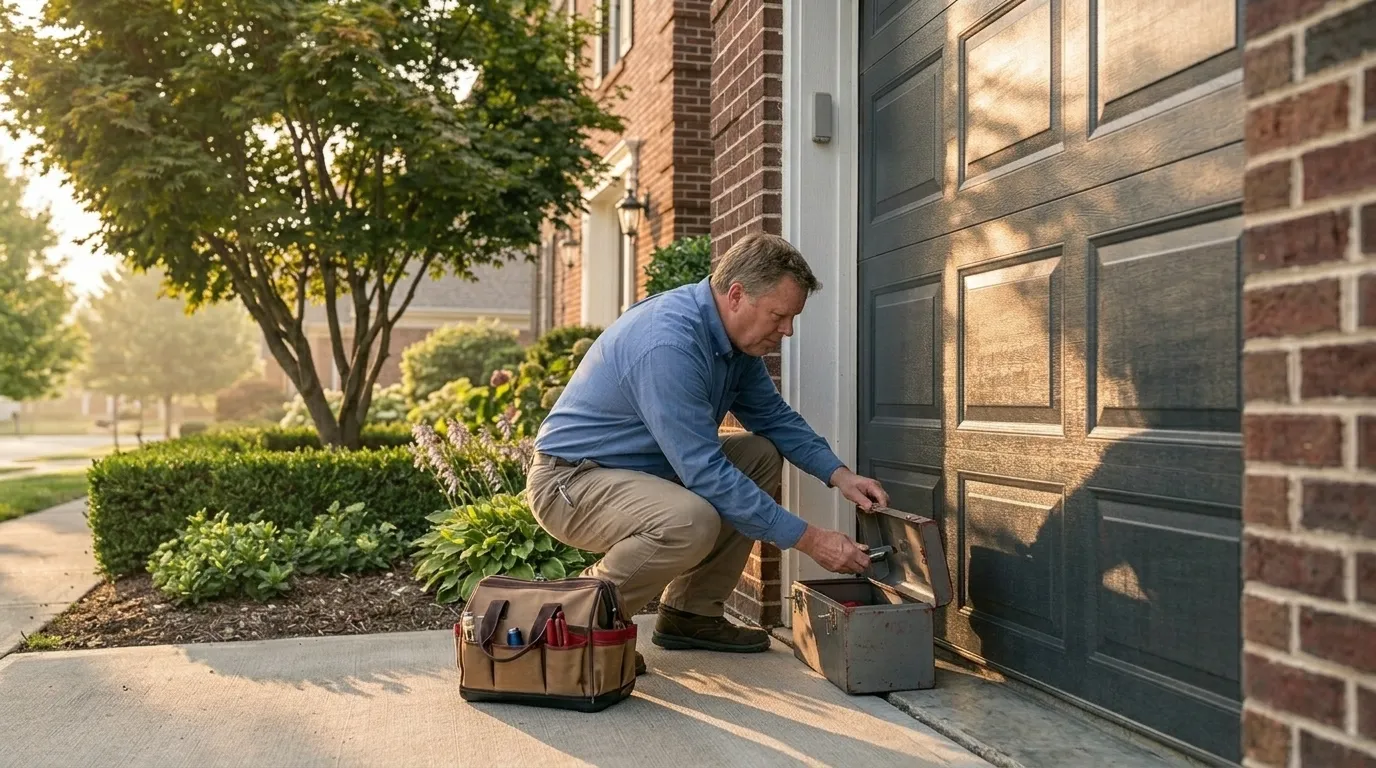
Most of the calls we get from this part of the Midway involve doors that are older than the owner realizes. Housing across the wider service area went up mostly in the 1960s and 70s, and that's the stock we see block after block here: single-layer steel doors, torsion springs sized for a lighter door than what's actually hanging, and openers that are on their second or third remote by now.
Cold is the other constant. Minnesota's winters put steady stress on spring steel, and a torsion spring that's been cycling for thirty-plus winters usually lets go on the coldest morning of the year, not the mildest. That's not bad luck, that's metal fatigue meeting a hard freeze.
We also see a fair number of panel replacements where a single dented section is cheaper to swap than the whole door, and roller jobs where the original steel rollers have worn the track wide enough that the door walks instead of rolling straight. If your door is original to a house built in that 1960s-70s window, expect to talk about spring balance and weatherstripping before you talk about anything cosmetic.
Here's what we tell people straight, before we ever quote a job. A torsion spring replacement is a parts-and-labor job, not a mystery, and if your door was installed when the house was built, the spring has almost certainly outlived its rated cycle count. That's a repair, not a red flag.
Where it gets less simple is the cabinet-style openers some of these homes still have, or doors with hardware nobody makes replacement parts for anymore. When that happens, replacement is usually the honest answer, even though it costs more up front, because chasing parts for a 40-year-old track system can eat more in labor than a new door costs.
One limitation worth saying plainly: we don't stock every obsolete part for every era of door, and a same-day fix isn't always possible if the section or hardware has to be special-ordered. We'll tell you that up front instead of stringing out a repair that isn't going anywhere.
Housing in the areas we cover runs from 1956 to 2002, with a median build year around 1973 - and Hamline - Midway sits squarely in the older, denser part of that range, part of the broader pattern of 41 named areas built out mostly through the 1960s and 70s. That means original garage construction here tends to be single-car or narrow double bays, framed for the lighter doors of that period, with hardware sized to match.
The climate band for this whole area is classified cold and severe, which matters more for garage doors than people expect. A door built in the 70s wasn't speced with today's insulation standards, and an unheated garage attached to a house from that era loses more warmth through an uninsulated door than through the walls around it. When we're out on a call here, we're usually working with what the house actually has: original opening dimensions, original track spacing, and hardware that was standard for its decade but isn't standard anymore.
Hamline - Midway sits about 3 miles WNW of downtown Saint Paul, in the same general direction and distance band as Como Park (3 miles NW) and not far past Frogtown and Thomas - Dale, both about a mile NW of the center. That puts it in the older, inner ring of the service area rather than the newer suburban edges.
Across the full area we work, there are roughly 253,852 households and about 109,250 owner-occupied houses, with a median household income of $91,946. That's a wide range of housing ages and budgets, but the inner neighborhoods like this one skew toward the earlier end of the 1956-2002 build window, which is why so much of the work here is spring and hardware replacement rather than new-construction opener installs. If you're in this part of the Midway, we can generally get to you the same day we're already working nearby.
Cold, brittle spring steel under daily tension is a bad combination, and this area sits in a climate zone classified cold and severe. A spring that's cycled for decades is already near the end of its life, and a hard freeze is often what finally snaps it, not a random accident.
If the door was installed when the house was built in the 1960s or 70s, the panel steel and hardware are both old. We'll check the track and spring balance first - if the frame's straight and parts are available, repair usually makes sense. If hardware is obsolete, replacement is often the cheaper long-term call.
Not every part for every era. Some hardware from 1960s and 70s installs isn't made anymore, and we'll tell you honestly if a piece has to be special-ordered rather than promise a same-day fix we can't deliver.
Call now or request a free quote - same-day service on most repairs, upfront written pricing.